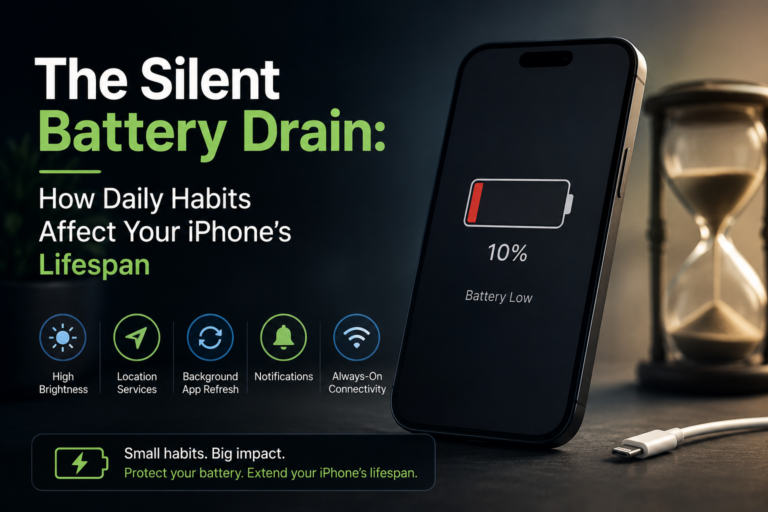
To put it bluntly, you are likely shortening your iPhone’s battery life every single day. This is not about a sudden, catastrophic breakdown. Instead, it’s about small, subtle habits that quietly erode your battery’s health over time. The most frustrating part is that it happens completely unnoticed.
Technicians encounter this scenario constantly. A user brings in an iPhone complaining that the battery no longer holds a charge. So even after an hour of placing a bitcoin bet on sports or just reading the news, they have to recharge it. The phone might only be six months old — sometimes even less. In almost every case, the culprit is how the phone is being used.
Let’s look at the facts, strip away the myths, and focus on practical steps that work in the real world.
Why iPhone Batteries Degrade Faster Than Expected
Your iPhone relies on a lithium-ion battery, a technology that thrives on balance and actively dislikes extremes. It struggles when left completely drained at 0%, and it experiences stress when pushed to a perpetual 100%. Chemically, it’s happiest hovering somewhere in the middle. Unfortunately, daily life rarely accommodates that middle ground.
Many users let their iPhone run down to the last remaining percentage points simply because it’s convenient. Then, they plug it in for an all-night charging session, occasionally using a low-quality third-party wall adapter. Together, these behaviors create a cumulative damaging effect.
A battery doesn’t fail overnight; it surrenders gradually. At first, it drains just a bit faster than usual. Then, the drop becomes noticeable. Eventually, you find yourself tethered to a portable power bank just to get through the afternoon.
The Most Common Habits That Shorten Battery Life
The most underestimated enemy of lithium-ion chemistry is heat. Many people routinely scroll through social media, stream video, or play games while their phone is plugged into a charger. The device heats up rapidly under this combined workload, and this thermal spike degrades the battery far more severely than the actual charging process.
Another widespread issue is leaving the phone plugged in long after it hits maximum capacity, especially overnight. While iOS features built-in software safeguards to manage power flow, the protective effect drops significantly if the phone is trapped inside a thick case or resting in a warm environment.
Cheap cables and off-brand power bricks introduce further risk. These budget accessories do more than just charge your phone slowly, they often deliver unstable voltage. Repair shops frequently see devices where substandard charging blocks have accelerated internal battery degradation.
Finally, there is the issue of cyclical stress. Constantly forcing the battery through wild swings — dropping to absolute zero and then getting blasted back to maximum — strains the chemistry. It is the hardware equivalent of an erratic sleep schedule; the system burns out from the constant instability.
How to Handle Charging in the Real World
The secret to extending your battery’s lifespan is remarkably simple, even if it sounds a bit tedious: try to keep your iPhone’s charge between 20% and 80% as often as practical. It does not need to be a perfect science, but making it a general habit yields significant results.
- Enable Optimized Battery Charging: If you absolutely must charge your phone overnight, make sure this feature is toggled on in your settings. Your iPhone will learn your daily routine and pause charging at 80%, waiting until right before you wake up to finish the final 20%.
- Manage Device Temperatures: If your iPhone feels hot to the touch, give it a break. Unplug it from the wall, remove any protective casing, and let it cool down at room temperature.
- Invest in Certified Accessories: Reliable charging gear is a direct investment in the longevity of your hardware. Stick to official Apple accessories or trusted, certified brands.
Why You Realistically Need to Act Now
The tricky part about battery degradation is its gradual pace. You adapt to the shorter lifespan over time, assuming it’s just a natural part of the phone’s aging process. It’s usually only when you handle a brand-new device that you realize how much performance you have actually lost.
The reality is that even a brand-new flagship iPhone can see its battery health plummet within a single year if subjected to poor charging habits. Conversely, a few mindful adjustments can keep that same phone running smoothly for several years without any noticeable drop in daily performance.