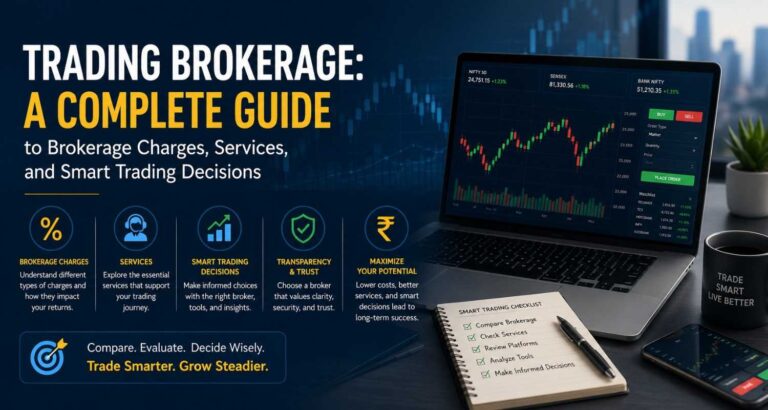
Only trading brokerage is the fee charged by a broker to execute buy and sell orders on behalf of investors and traders. It is a prerequisite for any stock market transactions and has direct impact on the overall returns from trades. Regardless of whether you trade equity, commodity, currency or future options, having an understanding of brokerage charges can help you effectively manage costs and make more informed investment decisions.
What Is Trading Brokerage?
Trading brokerage is the fee charged by a broker service in exchange for processing and facilitating transactions in financial markets. Brokers are intermediaries between traders and stock exchanges, ensuring that orders are processed effectively. Brokerage fees can vary from broker to broker as well as across trading segments and type of transaction. While some brokers take a percentage of the value to trade from you, others offer fixed-fee pricing models.
Types of Trading Brokers
Full-Service Brokers
Investment services for Full-service broker These include:
- Investment advisory
- Market research
- Portfolio management
- Wealth management
- Retirement planning
Dedicated relationship managers
These brokers to some extent charge a higher brokerage fees since they provides extensive services.
- Advantages of Full-Service Brokers
- Personalized investment advice
- Detailed market analysis
- Professional portfolio guidance
- Access to premium research reports
Disadvantages
Higher brokerage charges
Additional service fees
Discount Brokers
Discount brokers tend to be mainly trade execution for low prices. They offer online trading platforms but with little advice.
Advantages of Discount Brokers
Lower brokerage charges
User-friendly trading platforms
Faster order execution
Suitable for active traders
Disadvantages
Limited investment advisory
Basic research facilities
With a price breakthrough, bargain brokers have increased normality with retail shoppers.
Processing Of Brokerage Charges
Brokerage fees depend upon the pricing model followed by a broker. On the other hand, in percentage-based brokerage, a fee is calculated based on the total value of a transaction. On the other hand, flat-fee brokerage Charges a set fee for each trade irrespective to the size of braiding. It is important for traders to be aware of how their broker charges fees so that they can calculate how much it will cost to carry out a trade and whether the trade will be profitable.
Other Costs of Trading
Along with paying brokerage, traders also need to take into account other charges involved in a transaction such as Securities Transaction Tax (STT), Goods and Services Tax (GST), Exchange transaction charges, SEBI fees and Stamp Duty. The fees combined add up to the total cost of trading and even a small amount can make a big difference in returns particularly for active algorithmic traders executing hundreds of transactions per day.
Importance of Trading Brokerage
The overall profitability of investments is largely dependent on the choice of trading brokerage. Active traders tend to pay significant dollars in brokerage commissions over time, so selecting a broker with competitive pricing is vital. Since brokerage costs eat into a bigger piece of profits, lower commission can enable your traders to capture more gains in their execution or even better post-trade performance over the longer term.
Factors to Account for While Selecting a Broker
Investors need to consider factors beyond brokerage charges when choosing a trading broker. Other key aspects to look out for include the quality of a trading platform, order execution speed, customer support and research tools – local coverage and mobile trading are also important as well. A good broker must provide a secure and easily navigable platform that improves the overall trading experience and facilitates informed decisions.
Trading Brokerage By Segment
Normally brokerage chargers dependent on exchange section. The fees on equity delivery trades can be different from those of intraday trading as well. The same goes for futures, options, commodity and currency trading segments in brokerage structures. By having a good understanding of these differences, traders are able to select the most economical method of trading.
Now here are some of the benefits that come with using a brokerage calculator
Brokerage calculator: It helps traders understand the commission they must pay on a transaction before entering into a trade. It aids brokers in computing brokerage fees, taxes, and other expenses to give an idea of the net cost. A brokerage calculator helps traders make better decisions, plan trades more efficiently and be less surprised by unexpected costs.
Conclusion
Trading brokerage is an integral part of the process for investing and trading in financial markets. This means having a good understanding of how brokerage works; different fee structures, things that can impact trading costs to make wealth creation easier. Selecting the right broker can enhance profitability while managing transaction costs more efficiently to reach investment objectives.