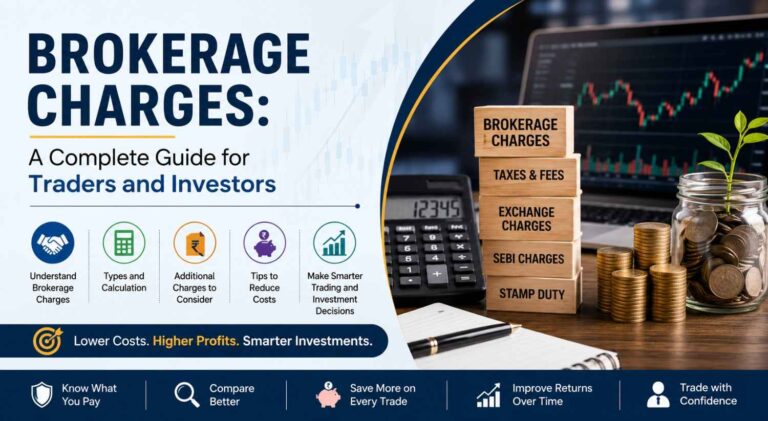
Among these, brokerage charges stand to be one of the most major costs that come into play making it vital with respect to trading and investing in financial markets. Brokers get their cut when you buy stocks (or trade futures and options) or when you invest in mutual funds or commodities. Awareness of the brokerage fees assists investors make calculated decisions, control trading prices and maximize actual returns. With the rise of online trading, the information provided here will cover how brokerage fees work for both novice and veteran traders.
What Are Brokerage Charges?
Brokerage Charges: These are the charges levied by a broker for placing buy and sell orders on their behalf. Brokers serve as intermediaries between investors and financial markets, offering trading platforms, access to markets, research resources, and customer service. They charge a brokerage fee in exchange for these services.
This can either be a fixed amount per transaction, or an amount as a percentage of the transaction. Brokerage charges vary from broker to broker, so it is imperative to compare brokerage charges before opening a trading account.
Types of Brokerage Charges
Depending on the type of trade and broker, you have a variety of brokerage charges. Full-service brokers (who generally are much more expensive) offer investment advice, research reports and portfolio management services. On the other hand, discount brokers mainly concentrate on executing trades and generally charge lower fees in return.
For intra-day equity trades or delivery of a particular stock, brokerage can be charged on a percentage basis (of the trade value) or even offered free by some brokers. Brokerage fees are typically levied on both the buy and sell sides of an intraday trade. Most futures and options trading comes with a fixed cost per executed order. Likewise, commodity and currency trading can have their own separate brokerage models.
Elements that Impact Brokerage Fees
There are many factors that determine the brokerage fee of any broker. The first one is the option of a broker you select. When compared to discount brokers, full-service brokers tend to charge higher brokerage rates. The other one is the segment of trading i.e equity, derivatives, commodities or currencies.
Trading frequency also impacts the total brokerage costs. Day traders who make multiple trades a day can have much higher brokerage commissions than long-term investors. Moreover, the overall brokerage amount can also depend on the transaction value or volume of trade and traders like to leverage promotional benefits which brokers offer from time to rushed into broker charges!
Additional Charges Beyond Brokerage
One of the biggest illusions among investors is that brokerage is the only cost involved while trading. In practice, there are more costs: Such as Securities Transaction Tax (STT), Goods and Services Tax (GST), exchange transaction charges, SEBI turnover fees and stamp duty.
While these charges are small in the approach, they compound over time and greatly influence profitability. Thus, traders should not look only at the brokerage fees but rather at all costs.
How Brokerage Is Calculated
The pricing model used by the broker determines how their brokerage calculation works. As an example, if a broker charges 0.3% brokerage and you buy ₹50000 worth shares, the broker will deduct ₹150 as a brokerage fee. In the case of a fixed brokerage in which a broker charges say ₹20 as fee, then irrespective of order size, brokerage shall be ₹20.
Most traders calculate the costs of trading in advance with the help of brokerage calculators before they go on to trade. These are the tools that automatically compute brokerage and taxes as well as additional fees, making it easy to see your overall cost per transaction.
Significance of Comparing Brokerage Costs
Before you choose any broker, make sure to compare brokerage charges. If you are a very active trader who executes hundreds or more trades every month, then lower brokerage fees can mean substantial savings. Although cost is important investors should also look at trading platforms, customer service and dependability plus available research tools.
While you may enjoy the broker with the lowest fees, if their platform is missing critical features or frequently has technical problemsन्तhe offering below are not going to make for your best choice. Hence, a balanced assessment on cost as well as service quality is suggested.
How can I save on brokerage?
Investors can lower brokerage costs or trading costs associated by selecting brokers having a net commission plan. A common way to reduce your trading costs is to use discount brokers. Traders should also refrain from overtrading as this can lead to high brokerage costs due to increased buying and selling.
A second valuable approach is to use brokerage calculators which enable buyers and sellers to get the cost estimates before placing orders. On a periodic basis comparing various brokers enables the investor best price plans and special offers. Your brokerage fees will be considerably less with long-term investing strategies in your comparisons than high-frequency trading.
Benefits of Understanding Brokerage Charges
Benefits of knowing the brokerage charges clearly It allows traders to better understand their real profits, manage costs, and make improved trading strategies. When investors can easily see all relevant fees, they are less likely to face surprises when it comes to the cost of doing business and are more empowered to make informed financial decisions.
Understanding brokerage fees ideally also aids investors in directly comparing brokers and electing for providers that are consistent with their personal investment objectives. Finally, learning about the costs of trading will lead to better financial planning and raising your investment efficiency.
Conclusion
Brokerage fees represent an integral element of the trading and investing process. These are the prices you pay to access financial markets via a broker and can have a material impact on your total return. This knowledge — knowing how brokerage is calculated, being aware of extra trading costs, and placing brokers side by side against one another — can help investors make more educated decisions on the best way to save costs while investing with a stockbroker. Whether you are an amateur or a professional trader, they must keep in mind the brokerage fees that later lead them to success and prove them financially secure for their future steps.